Walk the floor.
Start with the real process: the daily plan, the parts, the machines and the people making decisions. Find the handoffs that cost them time.
 THE SELF-OPERATING MACHINE
The machines are already there.
Now connect the decisions between them.
Scroll to bring the factory into focus.
A client asks for one number.
Five people go looking for it.
The day's plan sits in a spreadsheet. Material requests move through phone calls. The next shift inherits yesterday's gaps.
Every handoff is another place for the truth to disappear. You don't need another dashboard. You need the floor to speak the same language.
Start with the real process: the daily plan, the parts, the machines and the people making decisions. Find the handoffs that cost them time.
Turn the workflow into a system tuned to each role. Operators log work. Team leads plan. Management sees the same production picture.
Judge the system by the chasing it removes and the visibility it gives. Improve it with the people using it, on the floor.
AI-native operations software, tuned to each factory. No new hardware required for the software workflow.
Production first. Quality and maintenance alongside it. Different workflows, one factory story.
Planning & production
Work records, allocation and machine hours, purchase follow-up, and new-product tracking. Role-specific views for the people running the day.
Quality workflows
Bring repetitive quality work into the factory's operating system. The aim is to remove the manual effort around parts and product documentation.
This is a workflow-specific estimate. It is not a monthly figure, not a saving promised to every factory, and not counted again as a BMS result. Availability and fit are discussed for your workflow.
Maintenance intelligence
A prototype that connects fault history and OEM manual sections to an engineer's diagnosis, with human approval and a safety check on the proposed steps.
The demo uses synthesized incidents, not a customer's factory data. It is a maintenance-intelligence prototype, not a production rollout or an autonomous safety guarantee.
Active client factory groups
Combined revenue of those client groups.
Not Svayantra's revenue.
Estimated GM time saved, as reported by the founder. Actual impact depends on the workflow and adoption.
The same 6,000-minute estimate for a product with 250 parts. Shown in hours for context, not an additional saving.
See the workflow in a factory demo. Start with the handoffs that slow your team down, and judge the system by the time it gives back.
From connected records to an intelligence layer that helps the right people see, decide and act.
Svayantra Intelligence Assistant
The direction: factory-wide access shaped around each stakeholder, with an assistant that helps identify bottlenecks and, with the right controls, act on decisions.
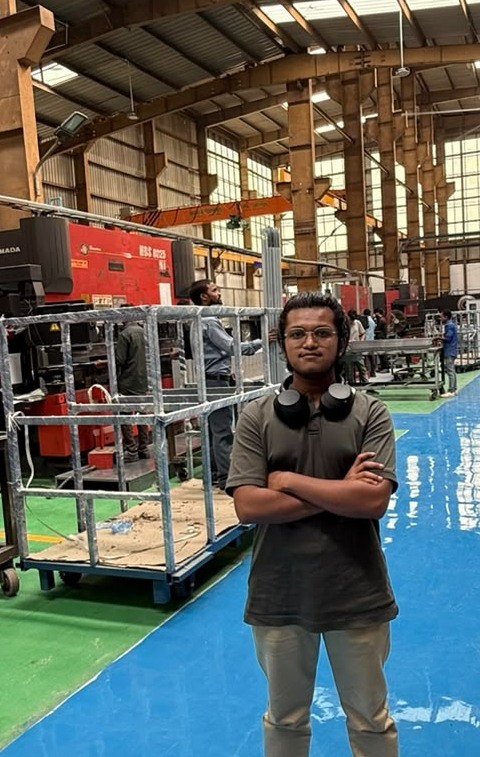
The product starts where the work happens.
Aryan Goud Kovelakonda founded Svayantra Tech to build software around real factory operations. Coding since 11. Building ventures since 16. Working beside the people who run the floor.
Not an off-the-shelf system with a factory label. A system shaped by the work itself.
Where does your team lose time?
Start with one workflow. The planning sheet nobody else can read. The part nobody can locate. The update that takes five calls.
founder@svayantra.tech ↗